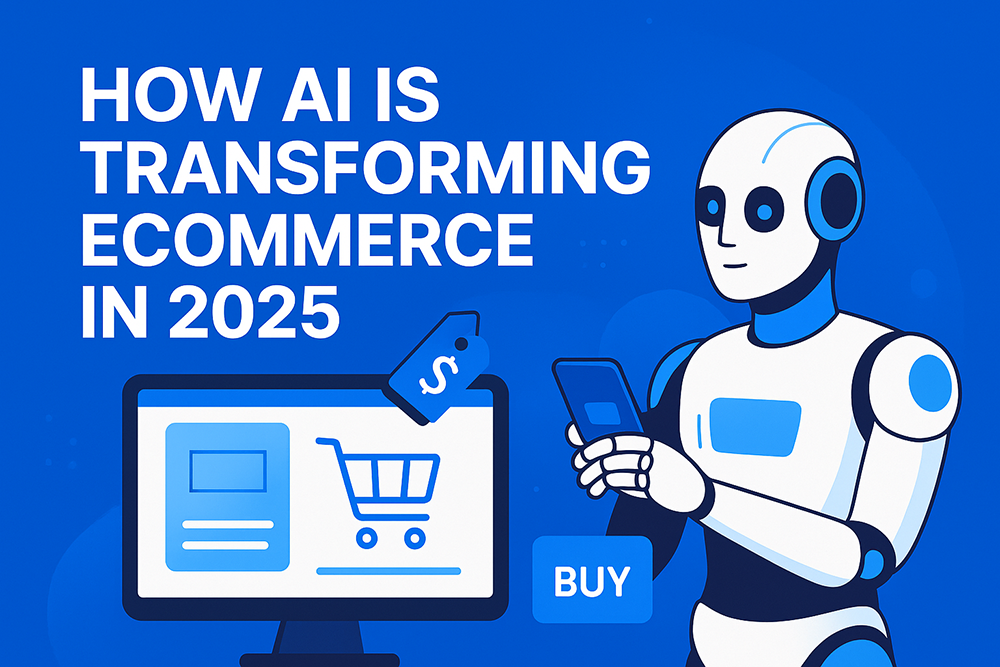
How AI is Transforming eCommerce in 2025
- admin
- No Comments
Artificial Intelligence (AI) has moved far beyond being a tech buzzword — it has become one of the most powerful forces reshaping the global eCommerce industry. From personalized shopping experiences to automated logistics, AI is now deeply embedded in every layer of digital commerce. In 2025, businesses that embrace AI are not only gaining a competitive edge but also setting new standards for customer expectations, operational efficiency, and long-term growth.
In this article, we’ll explore the key ways AI is transforming eCommerce in 2025 and how businesses can leverage these advancements to thrive in a highly competitive marketplace.
1. Hyper-Personalization at Scale
Personalization has always been the holy grail of eCommerce, and AI is making it smarter and more precise than ever. Today’s consumers expect brands to “know them” — from recommending the right products to offering personalized discounts.
AI-powered recommendation engines analyze customer browsing behavior, purchase history, and even real-time interactions to deliver tailored shopping experiences. Unlike traditional segmentation, these algorithms work at an individual level, ensuring that every user sees content and products most relevant to them.
For example, AI-driven platforms can predict when a customer might be running low on a product and suggest a timely reorder, or adjust product recommendations based on seasonal trends. This level of personalization not only improves customer satisfaction but also increases average order value and loyalty.
2. Smarter Customer Service with AI Chatbots
Customer support has long been a challenge for eCommerce businesses, especially with increasing demand for 24/7 service. In 2025, AI chatbots and virtual assistants have evolved to handle far more than simple FAQs.
Powered by natural language processing (NLP), these bots can now engage in human-like conversations, understand complex queries, and even upsell products during customer interactions. Some advanced systems integrate with CRM tools to pull up customer history, allowing bots to provide highly contextual support.
The result is faster response times, reduced support costs, and higher customer satisfaction. While human agents are still essential for handling sensitive or complex cases, AI is taking on the bulk of repetitive tasks, freeing teams to focus on strategic improvements.
3. AI-Powered Inventory & Supply Chain Optimization
Managing inventory has always been a balancing act: too much stock leads to losses, while too little means missed sales opportunities. AI is solving this by enabling predictive inventory management.
By analyzing historical sales, market trends, and even external data such as weather or economic indicators, AI systems can forecast demand with impressive accuracy. This helps businesses reduce overstocking, minimize stockouts, and optimize warehouse space.
In logistics, AI is streamlining everything from route optimization for deliveries to dynamic supplier management. Large retailers are already using AI-driven systems to automatically restock items before they run out, ensuring smoother operations and better customer experiences.
4. Advanced Fraud Detection & Security
As eCommerce grows, so does online fraud. In 2025, AI is a critical defense line against fraudulent transactions. Machine learning models analyze purchase patterns, flag unusual activity in real time, and prevent unauthorized transactions before they happen.
AI systems can also detect fake reviews, phishing attempts, and account takeovers with far greater accuracy than traditional systems. This proactive approach protects both customers and businesses, boosting trust and credibility in online transactions.
5. AI in Marketing & Customer Insights
Marketing is another area where AI is making a massive impact. Instead of relying solely on intuition or historical data, businesses can now leverage AI-driven insights to craft smarter campaigns.
AI tools can:
-
Analyze customer sentiment from reviews and social media
-
Identify high-value customer segments automatically
-
Predict the success of campaigns before they launch
-
Optimize ad spend by targeting the right audience at the right time
For example, AI can determine which products are trending and suggest the best time to launch a promotion. With AI automating these insights, marketers are empowered to focus on creativity and strategy while letting the data do the heavy lifting.
6. Voice & Visual Commerce
Another key trend in 2025 is the rise of voice and visual commerce, both powered by AI. Consumers are increasingly using voice assistants like Alexa, Google Assistant, and Siri to shop hands-free. AI ensures that these voice-based interactions are accurate, seamless, and personalized.
Meanwhile, visual search technology allows shoppers to upload images and instantly find similar products. This AI-driven capability reduces friction in the customer journey, making it easier to go from inspiration to purchase. For fashion, home décor, and lifestyle brands, visual commerce is proving to be a game-changer.
7. The Future of AI in eCommerce
Looking ahead, AI in eCommerce will continue to evolve beyond personalization and automation. With generative AI, businesses can now create dynamic product descriptions, personalized email campaigns, and even custom landing pages tailored to individual shoppers.
Additionally, as AI integrates with augmented reality (AR) and virtual reality (VR), customers will be able to experience immersive shopping journeys — from trying on clothes virtually to visualizing furniture in their living rooms.
Businesses that adopt these innovations early will have a significant advantage in capturing customer attention and driving conversions in an increasingly competitive digital marketplace.
Final Thoughts
AI is no longer optional for eCommerce businesses in 2025 — it’s essential. From hyper-personalized shopping experiences and smarter customer support to predictive inventory management and advanced fraud prevention, AI is redefining every stage of the online shopping journey.
For businesses, the key is not just adopting AI but doing so strategically: focusing on tools that align with their goals, scale with their operations, and deliver measurable value. Those who embrace AI today will be the leaders of tomorrow’s eCommerce revolution.